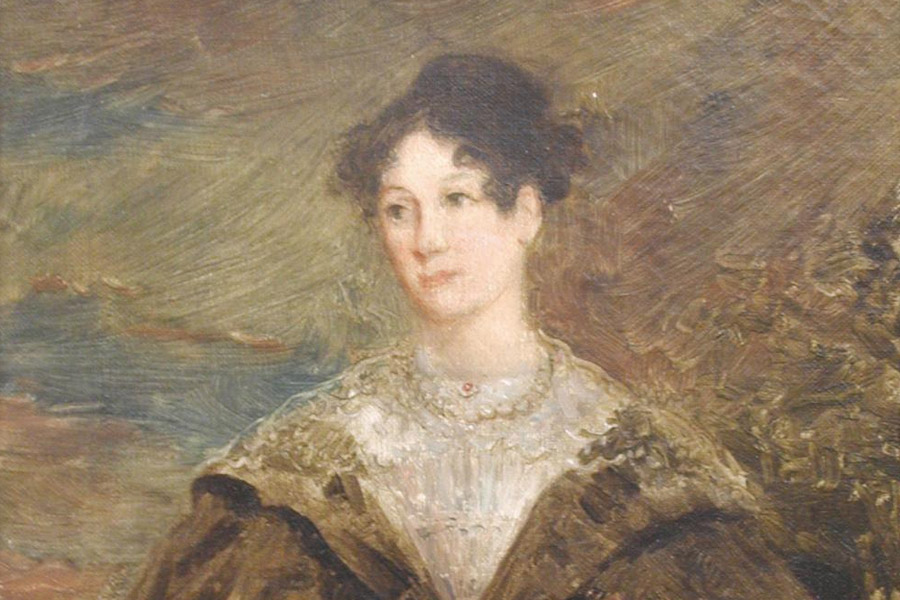
A Portrait of Mary Storer Potter
I think of Mary Storer Potter as a figure seen through soft glass. The details are selective, but the light is real. She was born on May 12, 1812, in Cambridge, Massachusetts, and she lived only until November 29, 1835, yet her brief life touched one of the most famous literary lives in American history. Mary is remembered today chiefly as the first wife of Henry Wadsworth Longfellow, but reducing her to that role would flatten her into a silhouette. She came from a prominent New England family, moved within educated social circles, and left behind traces that still shimmer in the historical record.
Mary belonged to a Portland, Maine, family with standing, property, and civic influence. Her father, Judge Barrett Potter, was a lawyer and probate judge, a man tied to law, politics, and the practical machinery of early nineteenth century Maine. Her mother, Anne Storer Potter, came from the Storer family line, another respected name in the region. Mary grew up in a household where public life and family reputation mattered. The world around her was one of structured manners, inherited responsibility, and careful social observation.
What makes her story vivid to me is the contrast between the small amount of surviving detail and the intensity of what followed. Her life was not long, but it was not empty. She married, traveled, shared in the orbit of a rising poet, and became part of the emotional foundation that shaped Henry Wadsworth Longfellow’s early adulthood.
The Potter Family Circle
Mary’s family is easier to trace than her inner life, but it exposes a lot about her upbringing. I regard the Potters as a prestigious but fragile household because numerous children died young while others lived linked lives as adults.
Barrett Potter, her father, is the family hub. Not only a local name. He shaped Portland’s legal culture as a judge, lawyer, and civic leader. Public trust and family prestige were strongly intertwined in his generation. That mattered to Mary. Such a family expected refinement, social awareness, and stability from its daughters.
Her mother, Anne Storer Potter, altered the family dynamic. While Mary was young, she died in 1821. The loss likely changed the home’s emotional architecture. A mother’s absence was often like a lost pillar in a home; the structure endured, but the weight shifted.
Mary had many siblings, and each one illuminates the family.
Mary’s older sister Elizabeth Ann Potter was born 1810. She lived long, never married, and remained a family member till maturity. Her presence suggests a sister who was both companion and stabilizer.
In 1813, Mary’s younger sister Margaret Louisa Potter was born. She married Peter Thacher and had a large family. She connected the Potters to other New England families. Margaret’s life illustrates how family networks in that age extended like branches over civic and social borders.
Louisa, John B., and Frances L. Potter died as children. Names matter even in short stories. They remind me that nineteenth-century families experienced joy and suffering simultaneously. Big families were frequent, but survival was uncertain. The Potter family knew that well.
Mary and Henry Wadsworth Longfellow
Mary’s most famous marriage was to Henry Wadsworth Longfellow on September 14, 1831. Their marriage united two Portland families from childhood. Some accounts say they were schoolmates, neighbors, and longtime friends before romance. Such origin stories are emotional. Less lightning than sluggish dawn.
Longfellow was still developing when Mary met him, but he would become a literary giant. A scholar and young professor, he balanced family expectations with intellectual desire. His career was growing when they met. Mary stood like a lamplighter at the start.
A few years passed, but the marriage was emotional. While Longfellow studied and prepared for Harvard, the couple journeyed to Europe in 1834. Mary shared that journey of private love and public advancement. Tragic events followed. During the trip, she miscarried and died in Rotterdam on November 29, 1835.
Longfellow was crushed by her 23-year-old death. The surviving references show the extent of such loss. It was a lasting grief. Crack in the foundation. Grief influenced his later poetry’s emotional register. Mary became one of those vanished figures whose remembrance lingers like perfume.
What Survives of Mary Storer Potter
The historical record for Mary is thin, but not silent. That matters. Many women of her time were preserved only in the margins of other people’s papers, and Mary is no exception. We know her through family history, letters, portraiture, and her connection to Longfellow. The record is fragmentary, but fragments can still gleam.
I think it is important to resist the temptation to treat her as merely a prelude to Longfellow’s later life. She had her own social world, her own family loyalties, her own place in the texture of Portland society. Her handwriting appears in some surviving manuscript materials, and her likeness has been preserved in portrait form. These traces do not build a full autobiography, but they do keep her from vanishing completely.
Her life also reveals the emotional customs of the period. Marriage, kinship, travel, illness, and memory all moved together. A woman like Mary was not measured by career accomplishments in the modern sense. Her significance came through family position, marriage, correspondence, and the emotional influence she held within her circle. That was a different kind of power, quieter but still real.
Timeline of a Short Life
Mary’s life can be traced in a few sharp dates, each one carrying more weight than its length suggests.
She was born on May 12, 1812.
Her mother died in 1821, leaving Mary within a changing household.
She married Henry Wadsworth Longfellow on September 14, 1831.
She traveled to Europe with him in 1834.
She died in Rotterdam on November 29, 1835.
That is a brief chronology, but it is enough to show a life that moved from family home to marriage to travel, then ended far too early. The dates are like stepping stones across a stream, and the water around them is full of loss and memory.
FAQ
Who was Mary Storer Potter?
Mary Storer Potter was the first wife of Henry Wadsworth Longfellow. She was born in 1812 and died in 1835. She came from a respected Portland family and is remembered through her marriage, family connections, and the emotional influence she had on Longfellow’s life and work.
Who were Mary Storer Potter’s parents?
Her father was Judge Barrett Potter, a lawyer and probate judge in Portland, Maine. Her mother was Anne Storer Potter, who died in 1821. Together, they raised Mary in a family of social standing and civic importance.
Did Mary Storer Potter have siblings?
Yes. Her siblings included Elizabeth Ann Potter, Margaret Louisa Potter, and three children who died young: Louisa Potter, John B. Potter, and Frances L. Potter. The surviving sisters carried the Potter family line into later generations.
Was Mary Storer Potter related to Henry Wadsworth Longfellow only through marriage?
Yes, her known connection to Longfellow is through marriage. They knew each other from youth in Portland, and she became his first wife in 1831. Their bond was personal long before it became historical.
Did Mary Storer Potter and Henry Wadsworth Longfellow have children?
No children from their marriage are known to have survived. Mary died young, and the family line continued later through Longfellow’s second marriage.
Why is Mary Storer Potter remembered today?
She is remembered because she was part of Henry Wadsworth Longfellow’s early life and emotional world, and because her short life left a strong imprint on the story of one of America’s major poets. Her family background, marriage, and early death make her a figure of quiet historical gravity.