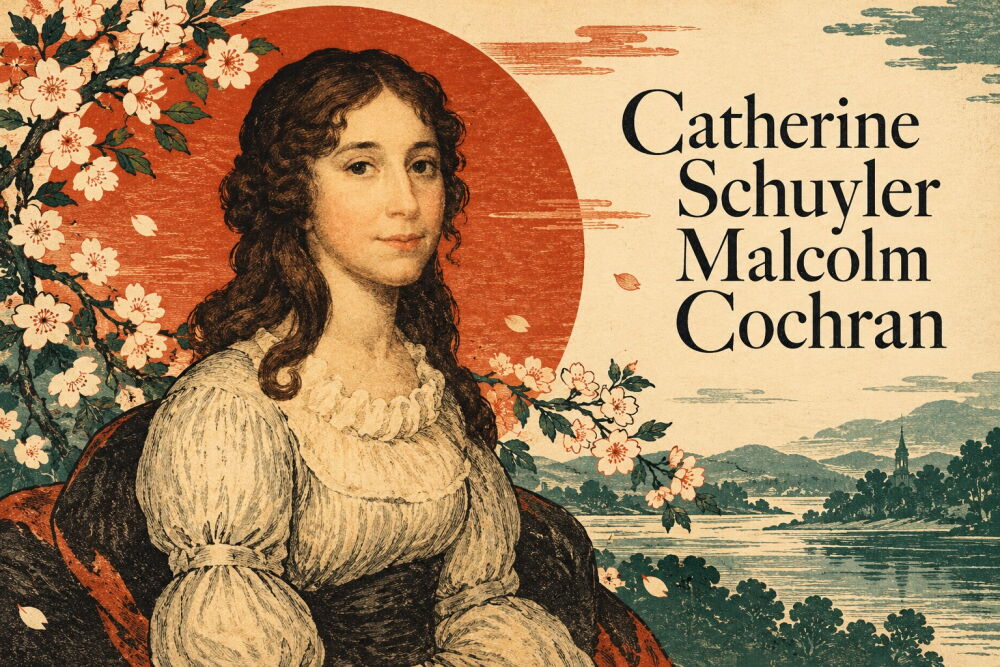
The Youngest Schuyler Daughter
A payment secured in the final year of her life gives Catherine Schuyler Malcolm Cochran a place in history beyond her famous family connections. In January 1857, she obtained $9,960 in compensation connected with her father’s Revolutionary service. I find that late effort especially revealing: an elite surname did not remove the need to pursue money owed or plan carefully for children.
Known as Caty, she was born February 20, 1781, and died August 26, 1857, aged 76. Her name also appears as Catharine, and Malcolm is sometimes spelled Malcom. Albany is the preferred birthplace, although another geographical identification appears in genealogical summaries.
She was the youngest daughter of General Philip Schuyler and Catharine Van Rensselaer Schuyler. Her life included two marriages, motherhood, inherited property, family correspondence, and a move from the Albany world to Oswego.
Parents and the Household She Inherited
Her father, Philip John Schuyler, lived from 1733 to 1804. A Revolutionary War general, landowner, and politician, he occupied a prominent position in New York’s early national history. Her mother, Catharine Van Rensselaer Schuyler, lived from 1734 to 1803 and belonged to another influential Dutch New York family.
I would not describe their household’s elegance without acknowledging the enslaved people whose labor supported it. Wealth and political importance were part of the setting, but so were the unequal relationships that made that setting possible.
Caty was much younger than several of the siblings most familiar today. The family included children who died young as well as eight who reached adulthood. Confusing an abbreviated adult family tree with a complete list of births would leave part of that history out.
Sisters Brothers and an Expansive Family Network
Caty’s sisters included Angelica, Elizabeth, Margaret, and Cornelia. Angelica married John Barker Church. Elizabeth, usually called Eliza, married Alexander Hamilton. Margaret, known as Peggy, married Stephen Van Rensselaer. Cornelia married Washington Morton.
Her brothers who reached adulthood were John Bradstreet, Philip Jeremiah, and Rensselaer Schuyler. Their marriages further connected the household with other established New York families.
I see those connections as a map of relationships rather than proof of Caty’s personal political influence. Being Alexander Hamilton’s sister-in-law did not make his career hers. His son Alexander Hamilton Jr. was her nephew, while Peggy’s son Stephen Van Rensselaer IV was another nephew.
| Relative | Relationship to Caty |
|---|---|
| Philip John Schuyler | Father |
| Catharine Van Rensselaer Schuyler | Mother |
| Angelica Schuyler Church | Sister |
| Elizabeth Schuyler Hamilton | Sister |
| Margaret Schuyler Van Rensselaer | Sister |
| Cornelia Schuyler Morton | Sister |
| Samuel Bayard Malcolm | First husband |
| James Cochran | Second husband and first cousin |
| William Schuyler Malcolm | Son |
| Alexander Hamilton Schuyler Malcolm | Son |
Samuel Malcolm and Motherhood in Utica
In 1803, Caty married Samuel Bayard Malcolm, an attorney who had served as personal secretary to President John Adams. The couple settled in Utica. The marriage came in the same year her mother died, followed by her father’s death in 1804.
Samuel’s death date remains uncertain. Different accounts place it in 1814, 1815, or 1817. The date falls within the 1810s; a precise year is not established.
Their sons William Schuyler Malcolm and Alexander Hamilton Schuyler Malcolm are securely identified. William, born in 1810, lived until 1890 and pursued maritime work before later public employment in Oswego.
Two additional children, Philip Schuyler Malcolm and Catherine Schuyler Malcolm, appear in less firmly established family details as having died young. Those names should not be placed on the same evidentiary footing as the two sons known to have reached adulthood.
James Cochran and the Move to Oswego
Caty married James Cochran in 1822. He was her first cousin, the son of her father’s sister Gertrude Schuyler Cochran. Born in 1769, James had a legal and political career that included Congress and the New York Senate.
In 1825, James, Caty, and her sons moved to Oswego. His later activities there included newspaper work and service as postmaster. I keep those offices attached to James. Caty is not established as an officeholder simply because she shared his household.
James died in 1848, leaving Caty widowed for a second time. Her surviving correspondence and property-related activity show a life continuing beyond both marriages.
Property and the Final Compensation Claim
Caty’s historical presence includes letters, leases, wills, inherited property, and legal documents. These are the quiet machinery of a family’s continuity. They also complicate the assumption that prominent ancestry guaranteed ready cash.
An 1851 family letter concerned possible mortgage relief. On December 11, 1855, a petition connected to compensation for Philip Schuyler’s service was presented to the Senate. The claim succeeded on January 16, 1857, with an award of $9,960.
Caty amended her will to divide the money between her sons. I find that practical action more informative than attaching a speculative modern net worth to her. It identifies an amount, a purpose, and a family decision without pretending to calculate her total wealth.
She died on August 26 of the same year. Her life had spanned the closing years of the Revolution and more than seven decades of the republic that followed.
FAQ
Was Caty the mother of the famous Schuyler sisters?
No. She was their youngest sister. Their mother was Catharine Van Rensselaer Schuyler, whose similar name can cause confusion.
Who were her husbands?
She married Samuel Bayard Malcolm in 1803 and James Cochran in 1822. James was also her first cousin.
How many sons reached adulthood?
William Schuyler Malcolm and Alexander Hamilton Schuyler Malcolm are identified as the two sons who reached adulthood.
What was the 1857 award?
It was $9,960 in compensation connected to her father’s Revolutionary service. Caty arranged for that money to be divided between her sons.